Showing posts with label svc. Show all posts

Friday, May 30, 2014

Polycom CloudAXIS 1.5 has been released

We just released Polycom CloudAXIS 1.5. That new release brings lot of new features like:

Support in CloudAXIS for Polycom’s SVC (Scalable Video Codec) solution
Improved user experience during video calls
Expanded scalability and lowered TCO for running the Real Presence Platform solution in the enterprise.

Support for Single Sign-On (SSO)
End users no longer have to sign in to CloudAxis if they are already logged into their Domain


Polycom room signature embedded in email invites
Users can join meetings with a single click from HDX/Group Series –giving end-users the flexibility of choosing how they want to participate in a conference call/

CloudAXIS Invitation on Group Series

CloudAXIS Invitation on HDX
Configure CA web users to come in at a controlled call rate
Enforce maximum bandwidth consumed for web users. Especially useful for external/guest users – IT managers can make sure that bandwidth is optimized keeping the network running smoothly.


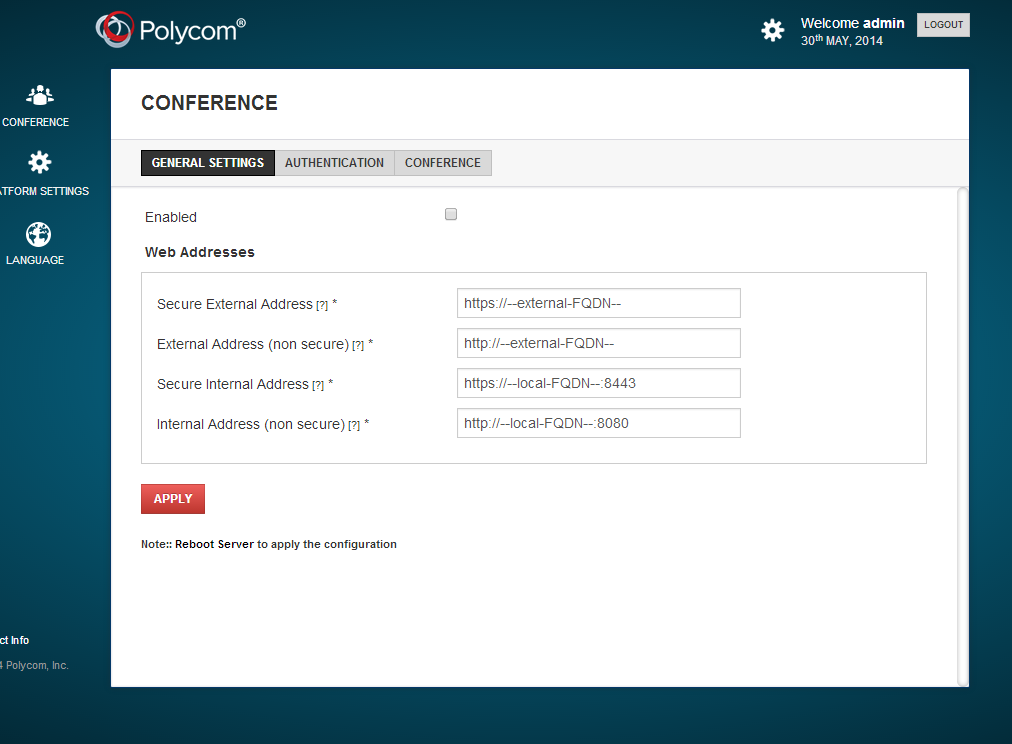
Improved  Experience Admin Portal for simpler install and management experience
GUI interface usable for administration rather than editing  a configuration file thus improving  the IT manager’s experience


Thursday, December 12, 2013

IBM Sametime 9 Video MCU: SVC, Bandwidth and Layouts

These last couple of months, I have published on this blog several articles on the new IBM Sametime 9 media framework. The purpose of this article is to discuss Sametime Video MCU. What you can do, resolution supported and different type of call involving clients (Rich, Mobile and Web).

Details on Video MCU

The Video MCU provides conferencing functionality in Sametime 9 environment. The main purposes of the Video MCU are to:
•    Handles media and media control from Sametime 9 clients
•    Routes H264 AVC (SVC base layer) and SVC video to video enabled clients
•    Routes Scalable Audio Codec (SAC) to Sametime 9 clients
•    Support audio transcoding and audio mix for clients which don’t support SAC

In a multipoint call handled by the Video MCU, each SVC EP (Sametime 9 client) encodes multiple simulcast resolutions of people video, and may request a number of media streams (at desired resolutions and frame rates) based on its capabilities and connected displays.

Regarding SVC implementation, IBM Sametime 9 supports Spatial and Temporal scalability.
The default operation point of IBM Sametime SVC are 720p, 360p, 180p in simulcast.
Each stream in the simulcast is scalable in the temporal domain – 7.5FPS, 15FPS, 30FPS.

Configuration of Video Conferences

In Sametime System Console, in Sametime Policies section, you can create Conference Template. Two conference modes can be selected:

•    SVC only – Mode to only support IBM Sametime 9 clients only, in SVC mode.
•    Mixed AVC/SVC mode – this is the default level.
•    AVC only - This conference mode is not supported


When you are in “Mixed AVC/SVC” mode, you can choose between 6 different configurations (presets) which derive different video levels:
•    Mobile optimized – 180p, 360p, 720p – very similar to the preset used today in SVC only mode, but allow AVC participants to join.
•    QVGA optimized-240p, 480p, 720p – aimed for AVC endpoints that are configured to prefer QVGA.
•    CIF optimized – 240p, 480p, 720p – aimed for AVC endpoints that are configured to prefer CIF.
•    VGA optimized – 360p, 720p
•    SD optimized 480p, 720p – aimed for AVC endpoints that are configured to prefer SD.
•    HD optimized – 720p only.

Performance & Bandwidth of the Video MCU

In the "Zero to Hero Sametime 9 deployment guide", you can find (slide 88) that table showing the number of concurrent calls at a certain resolution and codec supported with a specific hardware configuration.


IBM has written a wiki page with Video Resolution – Bandwidth requirement for multi-point call on the Video MCU: link

One important point you will see in the different configuration just below:
"To save bandwidth, the client sends a stream only if there is at least one remote client in the conference receiving it. So, for example, if no remote client is receiving 720p@15fps, then it is not sent. Only the streams 180p@30fps and 360p@15fps are sent."

Sametime Meeting with video Configuration

For all my tests, I have used a template with the maximum bit rate for the conference with a preset "Mobile optimized " and the Sametime Clients have an unlimited line rate (Full HD). So, I'm always using the maximum resolution/bandwidth.

1/ Config 1: Two participants

In that configuration, only two participants are connected in the video session. The two participants transmit and receive only one stream (720p@30fps)


Media Statistics (Outgoing and Incoming) of the right PC
2/ Config 2: Three participants with auto layout
In the previous call, a third person just joined. In that case, the video resolution, sent and transmitted by the Sametime clients, changes. All S9 clients sent a video stream (360p@30fps) and receive two video stream (360p@30fps). It decreases the upstream bandwidth, and you have a similar downstream bandwidth.


3/ Config 3: Three participants with one using the active speaker layout

One user change his video layout from Auto to Active Speaker in Full screen. So, the active speaker will have to send a new stream (720p@30fps).


Incoming stream. Only one 720p stream is received by the PC.
4/ Config 4: Four participants with one using active speaker layout, and one connected via an iPad

In that last configuration, we have a mix of configuration: Active speaker, auto layout and mobile client. In that case, all clients will have a different bandwidth utilisation.


The user is sending three different streams to cover all requests.
The user is receiving three different streams (two from rich clients, one from the mobile with a lower resolution).
That one is coming from the bottom user, who has set his layout “Active Speaker”
That's only four different use cases, but plenty of other configurations are possible. And, don't forget, you will be able to adjust the video resolution and bandwidth by playing with multiple parameter (client line rate, conference bit rate..)

References:

In addition to my tests, I have used these three interesting links.

  1. What's new in Sametime 9 audio & video: link 
  2.  Sametime Blog article from Julie Reed: link
  3. Sametime 9.0 Video Resolution Bandwidth Requirements: link
  4. IBM technote on Media Manager policy : link
Some terminology:
•   H264 AVC – Advanced Video Codec, the legacy form of H264, supported by most video room system and clients, including Sametime legacy clients before Sametime 9
•   H264 SVC – Scalable Video Codec, enable to transmit and receive different video levels in a single RTP stream
•   MCU – Multipoint control unit – handles conferencing in Sametime 9
•   VMGR – Video Manager – manage the cluster of MCUs in a Sametime 9 environment.
•   SAC – Scalable Audio Codec – enable high level audio quality mix with excellent error resiliency without transcoding at the MCU
•   Line Rate - The maximum bandwidth allocated to individual users joining the meeting.

Wednesday, September 18, 2013

IBM Sametime 9 Launch Event

IBM Sametime 9 launch event is just finished. That was a very good and original event.
It has been done through the IBM Virtual Event Center. That event was truly global. Polycom saw visitors from 27 different countries.

The format of this event was:
  • 10 virtual booths of which one from Polycom. All the IBM Polycom team was on the booth to answer to all questions/comments.


So, what do I have learnt from that event?

IBM Sametime 9 (eGA: Sep 20) will include:
  • Next-gen media framework with scalable media bridge and codecs (H264SVC), continuous -presence video and built-in integration with HW endpoints for meetings and IM.
  • Mobile IM and meetings client improvements including audio, video and mobile APIs
  • Enhanced integration with IBM Connection
  • Smarter Meetings, a new user experience with OneUI
John Delpizzo have shown that from a presentation delivered via an IBM Sametime 9 Meeting.

New, streamlined Sametime Experience

Continuous Presence

Mobile with Video
Codec details on IBM S9

IBM Sametime 9 and the seamless integration with Polycom portfolio will be available in all Polycom Experience Center worldwide, soon.
Come and experience it LIVE!!!

Next events:

1/ What's new in IBM Sametime 9
Join Marlon Machado on September 19 to learn about IBM Sametime 9's cutting-edge conferencing and communications capabilities that leverage your existing IT and infrastructure, mobile devices, and applications. -> link

2/ IBM Sametime 9 video functionality: Come see the excitement around continuous presence
Attend this free webcast on October 2 to get the lowdown on how IBM Sametime 9 allows for continuous video without the use of third-party technology and its parity with Microsoft Lync 2013 with David Price (Meridian IT) and Peter Lurie (Polycom). -> link

P.S: Big thanks to John Delpizzo, Luis Benitez, Suzanne Livingston, Julie Reed, Marlon Machado and Marc Pagnier... GOOD JOB!!!

Thursday, September 12, 2013

IBM Completes Sametime’s Front Nine by Wainhouse Research


Wainhouse Research has written an analysis on the next major release of IBM Sametime: Version 9.
IBM Sametime 9 should be available at september 20th.

Wainhouse Research has hightlighted two major enhancements for these release:
  • A simplified, streamlined user experience
"Both the browser-based and native Sametime clients have undergone a number of both look-and-feel and workflow refinements."

  • “Out of the box” Continuous Presence
"A new SVC-capable, software-based video conferencing capability supports conferences with up to 2,000 attendees, with the ability to view up to six simultaneous video streams (four on mobile devices), developed by IBM with guidance from Polycom."

Link to Wainhouse Research Bulletin: here

I will share with you, next week, more details, pictures on IBM Sametime 9, based on my tests during S9 beta program.

Wednesday, January 30, 2013

Social Communications (IBM Sametime) at IBM Connect

IBM Connect is almost done.. So, how did this IBM turn out ?
Key messages -> Social, Social, Social....

I have been very interesting by IBM Social Communications session this year as you can imagine.
I have followed some of them presented by former colleagues like John Delpizzo, Marlon Machado (Clevershutter), Julie Reed, Pat Galvin (@patgalvin)...

One sentence is the right illustration of what they have announced : "We have been listening", especially on the Video side...
They have addressed lots of challenges, listed just below:

Video Everywhere, Video Ubiquity..

Continuous Presence, instead of Voice activated switching Mode

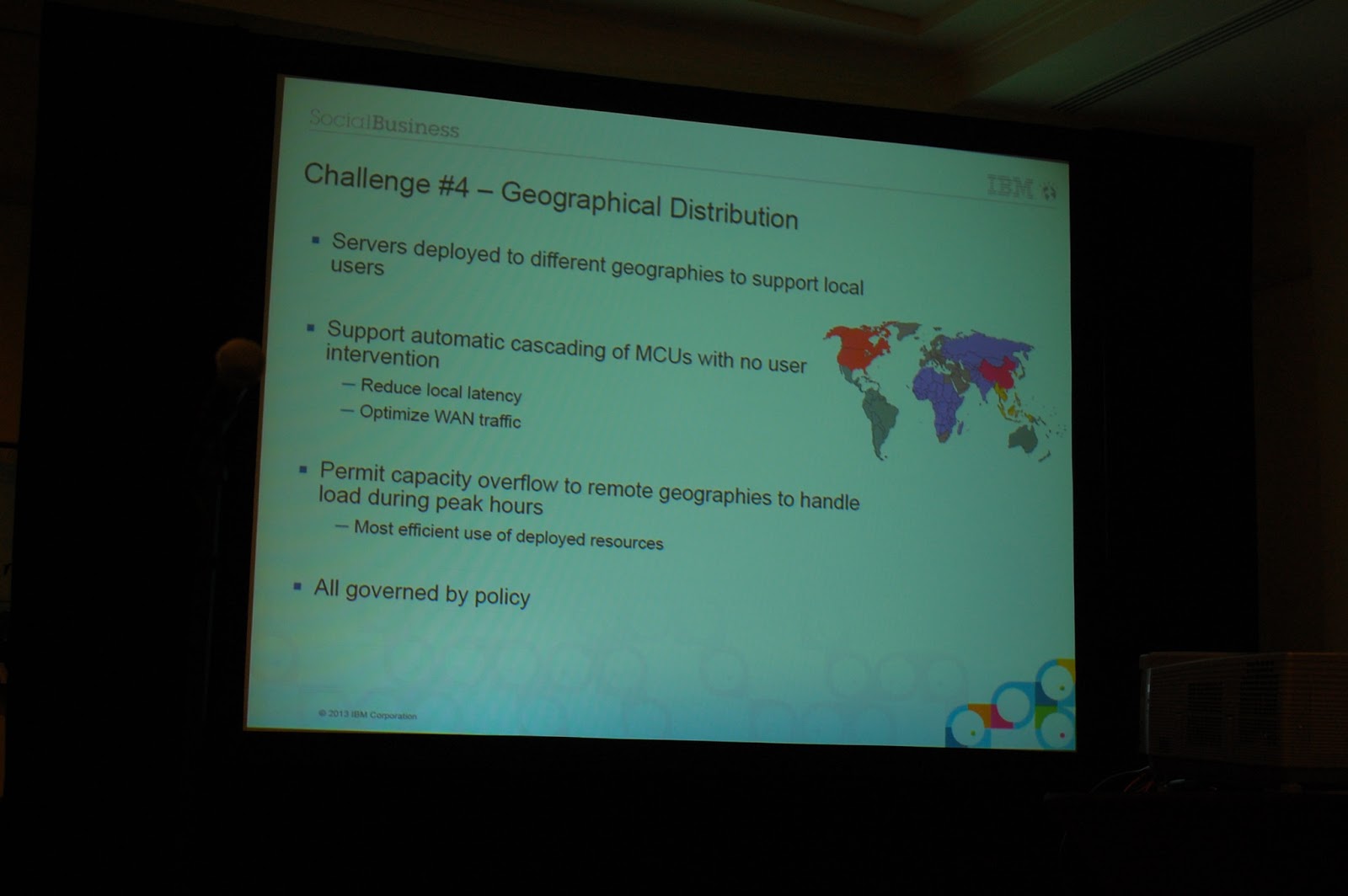
Geographical Distribution of IBM Sametime Video Engine

Interoperability - A key element to ensure easy integration in heterogeneous environment

High Availability for the best SLA, because rich Communications are becoming critical
To achieve all of these challenges, IBM has redesigned their video engine.


  • One : They plan to implement a new video codec in their platform -> H264 SVC in addition of H264 AVC (for backward compatibility). That's a really good news. I have explained the SVC protocol and its advantage here.

  • Two: Audio-Video everywhere -> Rich client, Web Client, Mobile Client...
  • Three:  A soft MCU for SVC Media Relay and AVC Voice Activated switching mode

So, the conclusion is that I want to play with IBM Sametime Next !!!

Thursday, October 25, 2012

Polycom & H264 SVC

One major announcement of Polycom in Q4 2012 is the implementation of SVC across
RealPresence environments and the RealPresence Platform.

Powerful Polycom® RealPresence® Platform enhancements include industry’s first open standards-based SVC (Scalable Video Coding), with 3X HD multipoint video call capacity for greater scalability, dramatically lower TCO, superior performance, and backwards- and forwards-compatibility to protect customer investments—all available through a software update. (link).

SVC is an adaptive technology that delivers a consistently high quality user experience across networks that may have varying degrees of quality of service or bandwidth available. SVC is one of the H.264 family of codecs, and is formally known as H.264 Annex G extension. It promises to increase the scalability of video networks and enable mass video deployments while reducing total networking equipment cost, because it leverages the processing power in the endpoints.

Traditional codecs encode entire video in a single packet stream

SVC codecs encode a base layer and multiple layers that enhance the base information, dependent upon what the network and endpoint can support, allowing for flexible delivery and consistent quality
Instead of sending one resolution, one frame rate, and one quality, as AVC H.264 video endpoints do, SVC video endpoints send multiple layers of resolutions (spatial), frame rates (temporal), and quality, dependent upon what each endpoint and the network can support. This allows for “scalability,” that is, for removing layers of the video without any additional video processing (coding or decoding), and for graceful degradation of the video quality when the endpoint or network conditions cannot support it.

SVC Benefits
SVC is an adaptive, bandwidth-efficient technology that delivers a consistently high-quality user experience across networks with varying degrees of quality of service.
The elimination of transcoding in the video network leads to immediate reduction of the end-to-end delay on multipoint calls. Since delay is the most important obstacle to interactivity, delay reduction is expected to lead to more natural and lively conversations on SVC multipoint calls.

A more details document: http://docs.polycom.com/global/documents/whitepapers/more-scale-lower-cost-scalable-video-coding-wp.pdf

More details on AVC: http://en.wikipedia.org/wiki/H.264/MPEG-4_AVC
More details on SVC: http://en.wikipedia.org/wiki/Scalable_Video_Coding

Tuesday, October 9, 2012

Polycom 2.0

Yesterday, Polycom made history...
We have made four industry-transforming announcements.
  1. New endpoints & New User Experience,
  2. Open SVC standard,
  3. New Portfolio of Mid-market Solutions,
  4. RealPresence Axis Suite.
I would like to spend more time on CloudAxis, whis is truely AWESOME...
CloudAxis Suite is a new product that extends enterprise- grade video collaboration to Skype, GoogleTalk, and business video apps through a browser: making B2B and B2C collaboration possible. That's important, because it enables organizations to collaboration outside their firewalls, easily with their Business Partners and Customers.

Via an universal browser access, without specific download, end-users will be able to join a collaboration session with you... That platform will be the first industry Global Presence Directory to agregate presence and adress list from Skype, GoogleTalk, Facebook, Microsoft Lync, IBM Sametime and other presence apps...

Now, let me share some screenshots to share with you the user experience.

Host can start a call and invite those contacts from the global directory.

Invitees receive link in Chat Window and launch their browsers.

Secure Multipoint Video Session

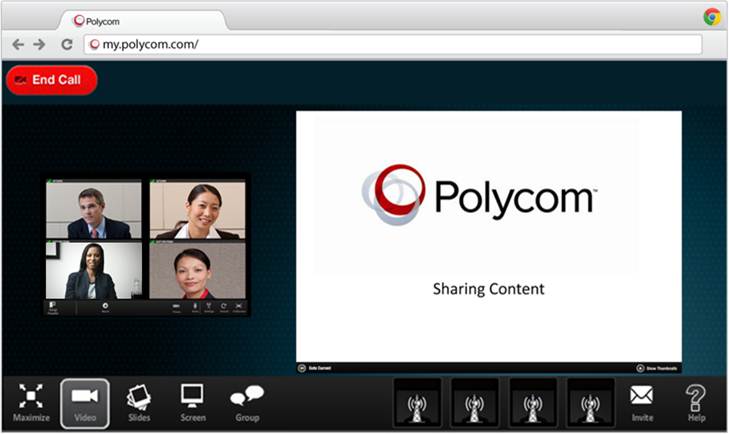
Participant View with Content Sharing.

To sum up, that new offering will allow you as Polycom customers to extend enterprise-grade video collaboration from rooms, theaters, desktops, tablets and smartphone to billions of users on any presence video app, any brower, any device...